Looking beyond impression share: identifying more reliable metrics for scaling your Performance Max campaigns

Looking beyond impression share: identifying more reliable metrics for scaling your Performance Max campaigns.

Looking beyond impression share

Are you looking to scale Performance Max campaigns, but unsure what metrics to look at to judge the success of adding more budget?


As a dealer, you may be used to looking at Impression Share in your Search campaigns to see if you’re reaching everyone in your area searching for “car dealers near me.” Unfortunately for Performance Max, this metric isn’t as reliable because this campaign type can serve in various placements outside of Search (including Shopping, Display, YouTube, Maps) and doesn’t rely on keywords. This essentially gives us no way to accurately measure all possible impressions.

So, how do you determine when to add more budget to your PMAX campaign? It’s important to first think of what your goal is. If the ultimate goal of the campaign is to generate leads, then conversion rate & CPA should be the main KPIs used to evaluate success.


How to determine how much budget to add.

At the campaign level, a “limited by budget” status may appear for campaigns that Google deems underfunded, and it will provide a recommended budget and expected lead lift. While we review these metrics to determine what is possible, your search team ultimately takes into account your overall performance and goals before providing a budget recommendation.

While we don’t use impression share to judge market share with PMAX campaigns, we can look at the impression share lost to budget. This metric gives us an idea of how much budget we need to add to a campaign in order to have the campaign fully funded.

For example, the below screenshot of this column in Google Ads suggests 24 - 44% more budget be added for three campaigns. An important note when looking at the impression share lost to budget is that this only accounts for the search placement, while your Performance Max campaign is also serving Vehicle Ads and additional Google placements. This metric is a good guide of where to start, but it may take more budget to raise both the search & shopping presence of your campaign.

Google Budget Recommendations Table

These budget recommendations are also specific to your campaign's current location & audience targeting. If your dealership is also considering expanding your audience, your paid search team can use the additional tools mentioned above to recommend a budget in this scenario. Current campaigns should be funded fully before expanding.

When scaling campaigns, we do expect to see some increase in CPAs, but the volume of leads should still be steadily increasing. We recommend increasing the budget by 20 - 25% at a time. As an additional best practice, incremental budget should first be used to ensure your search campaigns are fully funded before adding budget to your PMAX campaign.


How to evaluate success at scale.

These tools all give you a starting point to scale from. When an incremental budget is added, we recommend waiting at least one full month before judging success.

A few key metrics should be monitored to ensure campaigns remain efficient & not overfunded after this point. If CPAs rise by more than 50% and remain high, this can be a sign to lower the budget to remain efficient. The goal is to get more leads, and not to pay more for the same leads you were receiving before.

Your search manager can also take a look at the channel reporting tool available for PMAX and see if your channel split has changed dramatically since adding budget. If, after a month, the new budget is going towards Search & Shopping placements, that is a good indication that you are still reaching high-value customers.

If the percentage of the budget going to channels like Display, Discover & Gmail has risen, this isn’t necessarily bad, but it's best practice to check whether those channels are converting for you. If spend is higher on placements without incremental leads, this is a sign you may want to dial back to your original budget levels.


Performance Max scaling best practices.

  • Ensure the goals you are measuring success by are set up correctly
  • Use impression share lost to budget as an indicator to adjust budgets
  • Increase the budget by 20 - 25% at a time
  • Review Google Channel Placements to gauge if campaigns are overfunded
  • Allow one month for campaigns to optimize towards their new spends before evaluating performance

Bottom line.

There are now many tools available in Performance Max campaigns to judge the success of the campaign, if it’s fully funded & what opportunities may be available for your dealership. When your goal is leads for your dealership, it’s important to consider the efficiency of your leads and not just look at how often your ads are showing up for relevant sources.

The best way to determine success is to evaluate performance based on the historical campaign performance, for an accurate look at how your additional spend performed. Lead volume, conversion rate & cost-per-lead will all be important factors.


Want to connect about your digital strategy?

Fill out the form below and someone from our team will reach out to you to set up a time to connect.

Fields marked with * are required

    Meta lead generation campaigns

    Meta lead generation campaigns: how dealerships can drive higher-quality leads.

    Meta lead men

    What are Meta lead generation campaigns?

    Generating leads isn’t enough. Generating qualified leads is the real challenge. That’s where lead generation campaigns on Meta Platforms stand out. With native, in-platform forms and advanced customization options, dealerships can capture intent-driven prospects while maintaining control over lead quality.


    Why Meta lead forms work for dealerships.

    Meta’s lead forms reduce friction by keeping users within the app and auto-filling key information such as name, phone number, and email. This creates a smoother user experience and typically drives higher conversion rates compared to traditional landing pages.

    But volume alone isn’t enough. Quality is what ultimately drives sales.

    Features That Improve Lead Quality.
    1. SMS Verification
      One of the simplest ways to improve lead integrity is through SMS verification. By requiring users to confirm their phone number via a one-time passcode, dealerships can:

      • Reduce fake or duplicate submissions
      • Ensure contact information is accurate
      • Prioritize high-intent leads
    2. Custom & Conditional Questions
      Meta’s form builder allows dealerships to go beyond basic contact information and ask more meaningful questions, such as:

      • "What vehicle are you interested in?"
      • "When are you looking to purchase?"
      • "Do you currently have a trade-in?"

      With conditional logic, the form can dynamically adjust based on responses. For example, if a user selects “Yes” for trade-in, additional fields can appear to gather vehicle details. This not only improves the user experience but also arms your sales team with better context before the first touchpoint.

    3. Higher-Intent Form Settings
      Meta also offers a “Higher Intent” form type that adds a review step before submission, helping filter out accidental or low-effort leads.

    Seamless CRM integration.

    Capturing leads is only half the battle—speed and efficiency in follow-up are critical. Meta’s lead ads integrate directly with most major dealership CRMs, allowing for:

    • Real-time lead delivery
    • Automated follow-up workflows (email/SMS)
    • Better tracking of lead-to-sale performance

    This seamless integration ensures no lead falls through the cracks and helps your team respond while interest is still high.

    Meta Huntington Beach Mazda


    Turning leads into sales.

    When paired with strong creative and clear offers, such as trade-in bonuses, limited-time financing, or new inventory highlights, Meta lead generation campaigns become a powerful engine for dealership growth. The key is balancing accessibility with intentional friction to ensure you’re capturing serious buyers, not just clicks.

    If you’re looking to increase both the volume and quality of your leads, Meta’s lead generation tools, when used strategically, can deliver measurable impact for your dealership.


    Want to connect about your digital strategy?

    Fill out the form below and someone from our team will reach out to you to set up a time to connect.

    Fields marked with * are required

      April 2026 Google & AI advertising updates

      April 2026 Google & AI advertising updates.

      2026 April advertising updates.

      Google continues to expand how AI supports paid search, and the latest updates give dealerships more control while increasing automation. These changes are designed to help campaigns scale faster without losing brand consistency.

      For dealerships, success comes down to balance.

      You need to let AI optimize performance, but still guide it so your messaging stays accurate, compliant, and aligned with your brand.


      AI Max and Performance Max text controls give you more control over messaging.

      Google has rolled out text controls and brand guidelines inside AI Max and Performance Max campaigns. This allows you to guide how AI writes your ads and what it should avoid saying.

      This matters because AI-generated copy can sometimes miss the mark. Now, you can define rules in plain language, such as avoiding certain phrases or preventing messaging that could misrepresent your pricing or offers.

      What dealers should do now:

      • Set clear brand guidelines inside campaigns
      • Identify phrases or claims to avoid
      • Review ai-generated copy more regularly

      This update helps you keep automation while protecting your brand voice.


      Ads in Gemini signal where AI advertising is heading next.

      Google has announced plans to test ads inside Gemini in 2026. While there is no way to advertise yet, this signals a major shift in how ads may appear in AI-driven experiences.

      For dealerships, this means future visibility may extend beyond traditional search results. Ads could appear inside conversations where users are researching vehicles, services, or financing options.

      What dealers should do now:

      • Monitor updates around Gemini ads
      • Prepare for more AI-driven discovery
      • Focus on strong data and content foundations

      There is no immediate action, but early awareness will matter as this develops.


      Performance Max video updates expand your creative automatically.

      Google is now automatically enhancing video assets in Performance Max campaigns. This includes creating shorter versions, adjusting formats for different placements, and adding voice-overs.

      These updates help extend your reach by making your videos usable across more placements without extra effort.

      What dealers should do now:

      While automation helps scale, having your own well-produced assets will still deliver the best results.


      Animated clips introduce new creative options in Performance Max.

      Google is testing a feature that turns static images into animated clips using its Veo 3 technology. This gives advertisers a new way to create motion-based content without producing a full video.

      For dealerships, this creates an opportunity to make inventory or promotional assets more engaging with minimal effort.

      What dealers should do now:

      • Test image-based creative in Performance Max
      • Monitor how animated assets perform
      • Use this feature to support existing campaigns, not replace strategy

      This is another step toward faster, AI-driven creative production.


      Your April checklist.

      These updates show a clear trend. Google is giving advertisers more automation, but also more tools to guide that automation.

      To stay competitive, dealerships should:

      • Define clear brand and messaging guidelines
      • Invest in strong creative assets
      • Test new formats early
      • Stay informed on emerging AI placements

      AI will continue to shape how ads are created and delivered. The dealerships that guide it effectively will see stronger results.

      If you want help turning these updates into a clear strategy, we work with dealerships to align creative, data, and automation so every change leads to better performance.

      Reach out to us today for help building a smarter paid search strategy.


      Want to connect about your digital strategy?

      Fill out the form below and someone from our team will reach out to you to set up a time to connect.

      Fields marked with * are required

        Google’s vehicle feeds on search ads are now fully available

        Vehicle feeds on Google’s search ads
        are now fully available

        2026 Apple Maps Updates.

        Google has officially rolled out Vehicle Feeds on Search Ads out of BETA, marking a significant update for automotive dealerships looking to maximize visibility and drive more qualified traffic from their search campaigns.

        This ad format allows dealerships to showcase their inventory directly beneath search ads, giving potential buyers access to available vehicles without needing to click through multiple pages.

        At Green Line, we had the opportunity to participate in the BETA with several of our clients. The results have been promising, with improved visibility and stronger engagement from high-intent shoppers.

        What This Means for Dealerships.

        If your dealership already has a vehicle feed in place, you’re ready to go. Google will automatically begin showing your inventory alongside search ads when it determines the placement is relevant to a user’s query.

        There’s no additional setup required beyond having a properly configured feed, making this an easy win for dealers looking to enhance their paid search performance.

        Why It Matters.

        This update bridges the gap between search intent and inventory discovery, helping shoppers find exactly what they’re looking for faster, and helping dealerships connect with buyers at the right moment.


        Want to connect about your digital strategy?

        Fill out the form below and someone from our team will reach out to you to set up a time to connect.

        Fields marked with * are required

          March 2026 Google advertising updates: Reshaping dealership visibility

          March 2026 Google advertising updates:
          Reshaping dealership
          visibility.

          2026 Google advertising updates.

          Google's recent ad updates directly affect click-through rates, creative strategy, transparency, and early brand visibility in the auto buyer’s purchasing journey. Dealers that act on these changes now will have a head start going into Q2.


          Google tests third-party endorsements in search ads.

          Google is experimenting with showing third-party endorsements from external publishers directly under search ad descriptions. While this may feel new, advertisers will remember review extensions, which were deprecated years ago.

          Now, endorsements appear to pull in positive third-party validation below the primary ad copy. This new feature is important because search results are crowded. Dealers compete not only with other rooftops but also with third-party vendors. If a trusted publisher highlights your brand positively and that endorsement appears directly in your ad, it can instantly boost credibility.

          This could lead to:

          • Higher click-through rates
          • Stronger brand trust
          • Better differentiation in a competitive market

          Dealerships should closely monitor brand mentions and reviews. Reputation and public perception may soon influence paid search performance directly.


          Advertising in AI mode is here.

          Google’s AI mode provides conversational responses that often include shopping recommendations. Now, Google is testing new ad formats within these AI-driven results.

          Retail is the first category, but Google has signaled expansion into additional verticals, including travel and other industries.

          This is important because AI mode shifts visibility earlier in the buying process. Instead of appearing only when someone types a direct search query, sponsored placements may surface inside AI-generated recommendations.

          This could allow dealerships to:

          • Appear earlier in research conversations
          • Capture interest before traditional search clicks
          • Compete within AI-curated product suggestions

          Dealers who have not begun testing AI-powered campaign types should start now. Participation in newer formats often favors early adopters before competition intensifies.


          Performance Max gets meaningful updates.

          Performance Max continues to evolve with two important changes.

          First, Google has introduced native a/b asset experiments. Advertisers can now test creative variations without launching entirely separate campaigns. This lowers the barrier to structured testing and accelerates optimization.

          Second, Performance Max placement reporting has expanded. Advertisers can now see where ads were shown, including network type. While reporting still focuses on impressions, this represents incremental progress toward transparency.

          Improved placement visibility, even at the impression level, allows dealers to:

          • Better understand distribution
          • Evaluate brand safety considerations
          • Adjust creative strategy accordingly

          Demand Gen lookalike updates shift toward AI signals.

          Beginning in early March, lookalike segments inside Demand Gen campaigns moved from similarity tiers to audience suggestions. Advertisers using lookalikes will be automatically opted in, but can opt out.

          Instead of limiting reach to strict similarity thresholds, seed lists will now act as signals for Google’s AI to expand targeting beyond defined boundaries.

          This shift reflects Google’s broader direction. Instead of rigid targeting, AI will interpret intent and similarity more dynamically.

          For dealerships, this means:

          • Greater potential reach
          • Increased reliance on strong seed lists
          • More importance is placed on conversion tracking accuracy

          Dealers should audit their customer lists and ensure data quality is strong. The better your input signals, the stronger the AI output.


          What dealerships should focus on now.

          Across all four updates, one theme stands out: Google is blending automation, AI, and paid placement more deeply into search and discovery.

          Dealerships should:

          • Monitor third-party brand reputation
          • Begin testing AI-integrated ad formats
          • Use Performance Max asset experiments intentionally
          • Strengthen first-party data for Demand Gen

          AI will increasingly determine how and where ads appear. Dealers who provide clear direction through creative, data, and testing will outperform those who rely on default settings.


          Let us help you evolve your strategy.

          Google’s platform will continue to change. Your strategy should evolve with it. Green Line partners with dealerships to align creative, data, and automation so new updates translate into performance gains, not confusion.

          Let’s build a strategy that keeps your dealership ahead of the next shift.


          Want to connect about your digital strategy?

          Fill out the form below and someone from our team will reach out to you to set up a time to connect.

          Fields marked with * are required

            Green Line Automotive Named Among Top 3% of Google Partners Nationally for 2026

            Green Line Automotive named among Top 3% of Google Partners Nationally for 2026.

            Green Line Automotive named among Top 3% of Google Partners Nationally for 2026.

            For Immediate Release
            Rolling Meadows, IL — February 26 - 2026

            Green Line Automotive, the premier digital marketing partner for the automotive industry, is thrilled to announce its designation as a 2026 Google Premier Partner for the 8th year in a row. This prestigious ranking places Green Line Automotive in an elite tier of marketing experts, specifically recognized for driving high-performance Google Ads campaigns that move inventory and scale automotive brands.

            To achieve Premier status, Green Line met stringent criteria across three categories:

            Performance, Spend, and Certification. This ensures that Green Line clients are working with the most knowledgeable and effective Google Ads experts in the country.


            "The automotive sector moves fast, and our status as a Premier Partner ensures our clients move faster," said Brent Rogers, Co-Founder and Partner at Green Line Automotive. "Being recognized in the top 3% of the country means we have the data, the direct line to Google support, and the strategic edge to ensure our dealerships and auto brands dominate their local markets."

            Green Line Automotive’s 2026 Premier Partnership brings several high-value advantages to its automotive clients:

            • Promotional Offers: Enhanced Google Ads credits for new client accounts to jumpstart lead generation.
            • Tailored Recommendations: Direct access to Google’s customized account tips to improve campaign efficiency.
            • The Premier Badge: A trusted symbol that signals to the industry that Green Line Automotive is a master of the Google Ads platform.

            About Green Line Automotive

            Green Line Automotive is a specialized digital advertising agency dedicated to the automotive sector. By bridging the gap between Tier-1 technology and Tier-3 dealership needs, Green Line provides retailers with a competitive edge through customizable, high-tech marketing solutions. From Generative Engine Optimization (GEO) to comprehensive digital strategy, Green Line is committed to transparency and measurable dealer growth.

            Media Contact:

            Green Line Automotive Email: info@greenline.nyc
            Phone: 833-GLD-CARS
            Website: gldauto.com
            Facebook: @greenlinedigitalauto / https://www.facebook.com/greenlinedigitalauto
            Instagram: @greenlinedigitalauto
            LinkedIn: https://www.linkedin.com/company/green-line-digital-auto/
            X: @gldauto


            Want to connect about your digital strategy?

            Fill out the form below and someone from our team will reach out to you to set up a time to connect.

            Fields marked with * are required

              2026 Apple Maps updates: What dealerships need to know.

              2026 Apple Maps updates:
              What dealerships need to know.

              2026 Apple Maps Updates.

              Apple Maps is turning into a lot more than just a way to get from point A to point B. With better business management tools, deeper integration in iOS 26, and search ads likely right around the corner, Apple is making a serious play for how people find local businesses.

              For dealerships, having a solid presence on Apple Maps isn't a "nice to have" anymore—it’s a core part of being found.

              As Apple keeps doubling down on Business Connect and local search, the dealers that get their structure right now are going to have a massive head start on trust, visibility, and future ad opportunities.


              Getting your structure right.

              Apple Business Connect breaks things down into three levels: company, brand, and location. It sounds like a "boring fact," but how these play together determines exactly how you show up in a search.

              • Company is your legal entity.
              • Brand is the name customers actually know and look for.
              • Location is the specific rooftop (and you can have several under one brand).

              For dealer groups with multiple stores, this is huge. If these aren't aligned, your listings end up looking fragmented or inconsistent. That confusion costs you visits. When you get the structure right, you can update info centrally and keep your branding tight across every rooftop.


              Owning your listing.

              If you haven't claimed your dealership in Apple Business Connect yet, you’re basically leaving your local reputation to chance. Owning the listing is the only way to make sure your service hours are right, your photos look good, and your phone numbers actually work.

              Accuracy here is everything. Most people are searching for something specific—like when the service bay opens or how to get to the showroom. If that info is wrong, you aren't just losing a click; you're losing a customer. Plus, owning the listing protects you from random "suggested edits" and keeps you in the driver's seat as Apple rolls out new features.


              What IOS 26 means for the showroom.

              iOS 26 makes Maps more proactive. It’s better at suggesting routes and notifying users about delays, which means people are going to be staring at the app even more during their buying journey. If a shopper is navigating to your store, your Maps listing is literally their first interaction with your brand. We want to make sure it's a good one.


              Ads are coming to maps.

              The rumors are getting louder: Apple is planning to bring search ads to Maps soon. This is going to look a lot like how paid placements changed the game on Google Maps years ago.

              • Paid spots will likely jump to the top for category searches.
              • Early adopters will probably see lower competition (and lower costs) at the start.
              • Optimized organic listings will be the "foundation" you need to make those ads actually work.

              The bottom line.

              Apple Maps isn't just about directions anymore—it’s about being ready for where the local search market is headed. At Green Line, we're helping dealerships audit their listings and get their rooftops aligned before things get crowded.

              If you want to make sure your dealership is actually positioned to win on Apple Maps, let’s chat about getting an audit started.


              Want to connect about your digital strategy?

              Fill out the form below and someone from our team will reach out to you to set up a time to connect.

              Fields marked with * are required

                2026 Ai Search Trends

                BEYOND THE BUZZWORDS

                How AI and technical search took center stage at NADA 2026.

                Beyond the buzzwords: How AI and technical search took center stage at NADA 2026

                The shift from search results to Al answers.

                If you spent any time on the floor in Las Vegas this year, you felt the gravity shift toward Artificial Intelligence. However, for the modern dealer, the most critical takeaway wasn't about generative chat; it was about Generative Engine Optimization (GEO). Traditional search engine results pages (SERPs) are evolving into conversational answers. If your dealership’s website isn't technically structured to feed these Large Language Models (LLMs), you are essentially invisible to a growing segment of shoppers.

                To combat this, we have pioneered the use of LLM.TXT files. This technical layer acts as a roadmap for AI crawlers, ensuring your specific inventory, service offers, and brand values are accurately indexed and recommended by AI tools. In 2026, site health isn't just about load speeds—it’s about "crawlability" for the machines that influence your customers before they even click a link.


                Dynamic specials: winning the speed-to-market race.

                NADA 2026 highlighted a persistent pain point: the lag time between OEM incentive releases and dealer site updates. While many stores wait days for creative assets to be built and uploaded, the most profitable dealerships are now operating on a 24-hour cycle. Green Line’s Dynamic Specials Management eliminates the bottleneck by pushing offers to Search Results Pages (SRPs) and specials pages simultaneously.

                • OEM alignment: Incentives are updated within 24 hours of release, ensuring your price leader is always accurate.
                • Creative automation: We push dynamic banners directly to your SRPs, bypassing the traditional delay of manual creative requests.
                • Media efficiency: High Quality Scores on PPC campaigns lead to lower costs-per-click and higher conversion rates within your existing budget.
                • Unified strategy: We manage Sales and Service offers in a single fell swoop, capturing revenue across the entire dealership.

                A custom creative suite that scales.

                Consistency is often the first casualty of speed. At NADA, we saw too many dealerships with fragmented branding—a different "vibe" on Facebook than on their homepage. Our answer is a Custom Creative Suite that scales without losing the human touch. We provide responsive website banners, social video ads, and HTML email campaigns that are built to perform across every platform.


                Precision targeting with first-party data.

                The "spray and pray" method of digital advertising is officially dead. The most successful strategies discussed at NADA revolved around the Customer Data Platform (CDP). By integrating your CRM and DMS data, we can move beyond generic "in-market" buyers and target specific high-value personas:

                • Expiring leases: Reach customers 3 to 6 months before they need to make a decision.
                • Sold with no service: Target customers who bought a vehicle from you but haven't visited your service bay.
                • Service conquesting: Use location-based geo-fencing to reach customers visiting local competitors or independent repair shops.

                Actionable insights: your 2026 roadmap.

                NADA 2026 wasn't just a show; it was a wake-up call. To win this year, dealers must stop viewing digital marketing as a series of silos and start viewing it as a unified technical ecosystem.

                1. Audit your technical SEO: Ensure you have LLM-specific signals like LLM.TXT in place.
                2. Accelerate your offers: If your specials aren't live within 24 hours of the month starting, you're losing market share.
                3. Own your data: Stop relying solely on third-party audiences; leverage your own CRM to lower your cost-per-lead.

                Green Line Automotive remains committed to being the fastest in the country to market with offers and creative, backed by the highest performing KPIs in the industry.


                Want to connect about your digital strategy?

                Fill out the form below and someone from our team will reach out to you to set up a time to connect.

                Fields marked with * are required

                  February 2026 Google & AI Advertising Updates

                  February 2026 Google & AI advertising updates.

                  February 2026 Google & AI advertising updates.

                  What dealerships need to know about advertising in AI platforms.

                  Digital advertising continues to evolve, and the latest updates from Google and OpenAI offer a preview of where things are headed next. From ads beginning to appear inside AI tools to expanded audience targeting and creator partnerships,

                  these changes signal a future where AI plays a larger role in how shoppers discover dealerships—often before a traditional search ever happens.

                  For dealerships, the key isn’t reacting to every update. It’s understanding which changes matter now, which ones are worth watching, and how they could impact visibility and performance in the months ahead.


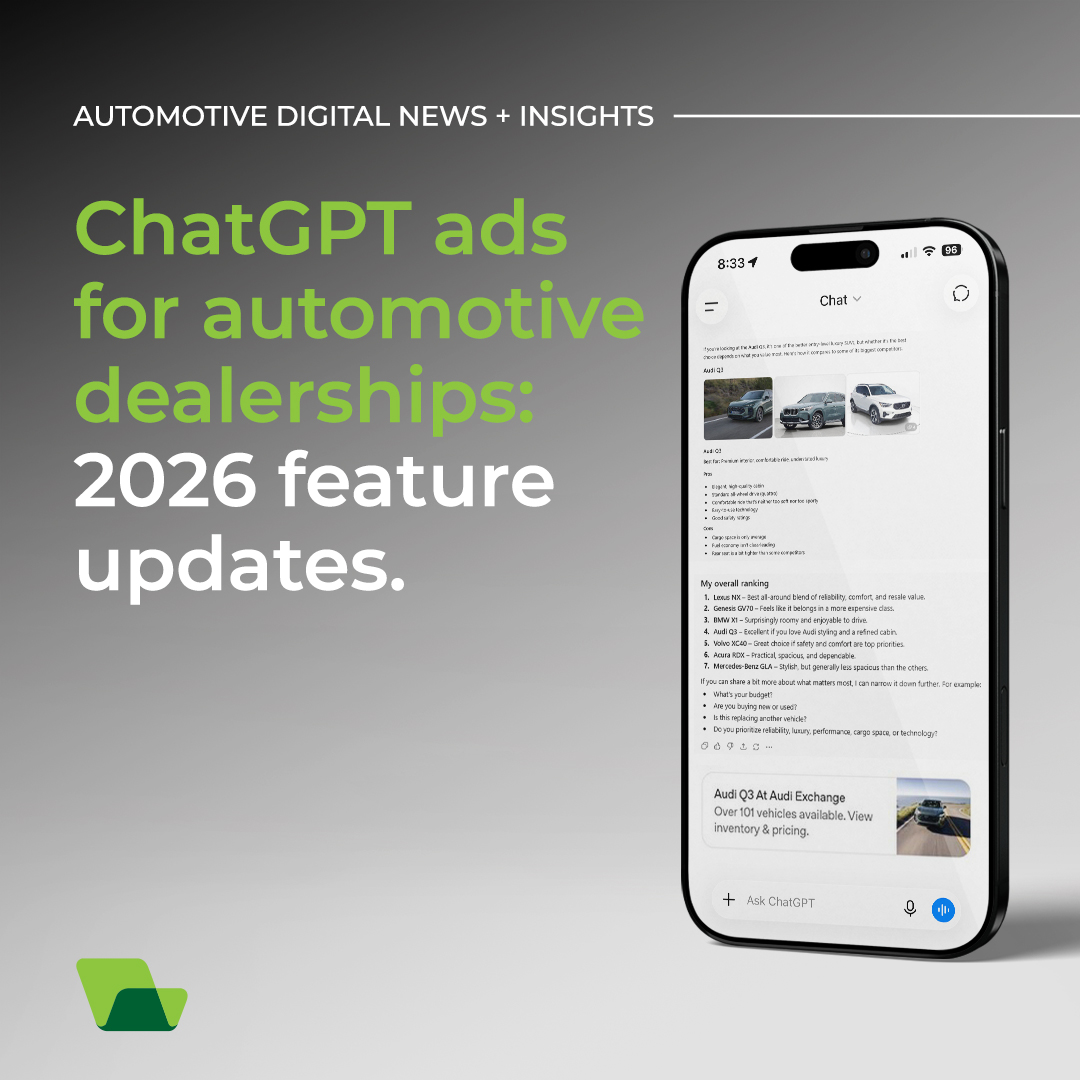
                  Ads in OpenAI and ChatGPT Are Coming.

                  OpenAI has announced plans to begin testing ads inside ChatGPT for logged-in adult users on free tiers. These ads will appear at the bottom of responses when relevant to a sponsored product or service. OpenAI has stated that ads will not influence how answers are generated.

                  Why this matters for dealerships
                  There’s no immediate action required. At this stage:

                  • There’s no way to advertise or enroll
                  • No targeting or reporting details are available
                  • This is an early test only

                  Still, this update is an important signal. AI-driven discovery is expanding beyond Google, and sponsored visibility inside AI tools could eventually become another channel dealers need to understand.


                  Google Lowers Audience Size Limits Across Ads.

                  Google has reduced the minimum audience size requirements across Search, Display, and YouTube. Audience segments with as few as 100 users can now be activated, down from the previous 1,000-user threshold. This applies to both remarketing and customer match lists.

                  Why this matters for dealerships
                  This is a meaningful change, especially for smaller and mid-sized dealerships. Lower thresholds make it easier to:

                  • Use customer lists sooner
                  • Launch remarketing with less traffic
                  • Build more precise, high-intent audiences

                  This update gives dealerships more flexibility and makes audience-based strategies accessible across more markets.


                  More Demand Gen updates continue to roll out.

                  Google is continuing to invest heavily in Demand Gen, reinforcing it as a key growth area.

                  What’s new

                  • Shoppable CTV through Demand Gen, allowing viewers to browse and purchase while watching YouTube on connected TVs
                  • A Brand Search attribution beta, showing how Demand Gen influences branded search (must be enabled by a Google rep)

                  Why this matters for dealerships
                  These updates show Demand Gen is moving beyond awareness. Dealers can use it to influence branded demand and support incremental conversions—especially earlier in the funnel. Google’s investment signals Demand Gen will be a larger focus heading into 2026.


                  Creator partnerships get easier on YouTube.

                  Google has enhanced its Creator Partnerships offering with a new Creator Search and Management Hub, making it easier for advertisers to find and work with YouTube creators.

                  Why this matters for dealerships
                  Creator partnerships are common on social platforms, but historically harder to activate on YouTube. These tools make it easier for dealerships to:

                  • Identify relevant creators
                  • Test creator-driven video content
                  • Build trust through authentic storytelling

                  This opens the door for more video-first, awareness-focused strategies.


                  What dealerships should do now.

                  Across all of these updates, one theme is clear: AI and advertising are becoming more flexible, more contextual, and more upper-funnel focused.

                  Dealerships should:

                    • Take advantage of smaller audience thresholds
                    • Begin testing Demand Gen if they haven’t already
                    • Monitor AI platform advertising developments

                  Stay flexible as new formats roll out


                  Want to connect about your digital strategy?

                  Fill out the form below and someone from our team will reach out to you to set up a time to connect.

                  Fields marked with * are required

                    How to improve your dealership AI exposure

                    How to improve your dealership AI exposure.

                    How to improve your dealership AI exposure.

                    AI is already shaping how car shoppers find dealerships. Between Google’s AI-powered search experiences, AI summaries in Chrome, and large language models that recommend businesses, visibility today depends on more than rankings alone.

                    Improving your dealership’s AI exposure means making sure your website and content are structured in a way AI systems can easily understand, trust, and surface.

                    If you’ve ever asked why your dealership doesn’t show up in AI searches, in most cases, the issue isn’t a lack of content—it’s how that content is structured and interpreted by AI.


                    AI exposure starts with technical health.

                    AI tools need clean, consistent access to your site. That’s why technical health remains the foundation of AI exposure.

                    At Green Line, these AI-focused technical updates have always been part of our strategy:

                    • Resolving 4XX and 5XX errors that block crawlers and reduce trust
                    • Fixing duplicate title tags and meta descriptions that confuse search engines and AI systems
                    • Identifying and repairing broken links that interrupt content discovery

                    These same fundamentals support high-performing digital strategies across channels, including social and paid media. We explore this connection further in Inside a High-Performing Dealership AI Social Strategy.


                    Why schema matters more in an AI-driven search world.

                    As AI becomes more context-driven, schema plays a much bigger role in how content is understood and categorized. Schema helps AI systems identify what your content is about, how it relates to other information, and when it should appear.

                    To support dealership AI exposure, GLD implements:

                    • Schema for AI-readable content
                    • Schema that supports rich snippets and enhanced results
                    • Additional structured data across all content, not just blogs

                    This structured approach is especially important as Google continues expanding AI functionality in search and Chrome.


                    Measuring AI health beyond rankings.

                    Rankings and traffic still matter—but they no longer tell the whole story. AI-generated answers don’t always result in clicks, which means dealerships need new ways to understand visibility.

                    That’s why we’ve added additional AI health analysis measurements, evaluating:

                    • How easily AI systems can access and interpret your content
                    • Whether your site structure supports AI-driven discovery
                    • How your content aligns with AI-powered search experiences

                    This mirrors what’s already happening in paid channels, where AI increasingly controls optimization and delivery. We’ve seen this shift firsthand in How Is AI Shaping Paid Social.


                    Using LLM.TXT files to support AI discovery

                    As large language models become more influential, helping them discover and interpret your content is critical. That’s where LLM.txt files come into play.

                    Green Line uses LLM.txt files to:

                    • Map dealership content for LLM tools
                    • Improve AI discovery across platforms
                    • Support placement in both AI-generated answers and traditional search results

                    This ensures your content is positioned for AI visibility and SEO performance—without forcing trade-offs.


                    AI and SEO are converging—not competing.

                    Optimizing for AI doesn’t replace SEO. It strengthens it.

                    Clean technical health, structured data, and clear content benefit both AI-driven discovery and traditional search. This convergence is a consistent theme across our AI insights—from social strategy to paid media—and it reinforces why AI exposure should be part of every dealership’s digital strategy.


                    Turning AI exposure into a competitive advantage.

                    AI exposure isn’t about chasing trends. It’s about making sure your dealership is visible wherever shoppers are getting information.

                    Dealers who invest now in technical health, structured data, and AI-friendly discovery will be better positioned as AI becomes embedded across search, browsers, and advertising platforms.

                    Let’s talk about how improving your AI exposure can support long-term dealership growth.


                    Want to connect about your digital strategy?

                    Fill out the form below and someone from our team will reach out to you to set up a time to connect.

                    Fields marked with * are required

                      Posts navigation

                      1 2 3 4 7 8 9
                      Skip to content